
Pusoy Dos Combinations: Can Your Hand Beat the Previous Play?
Check card count, combination and rank with clear Pusoy Dos examples using Philippine suit order, plus the rule variations to confirm first.
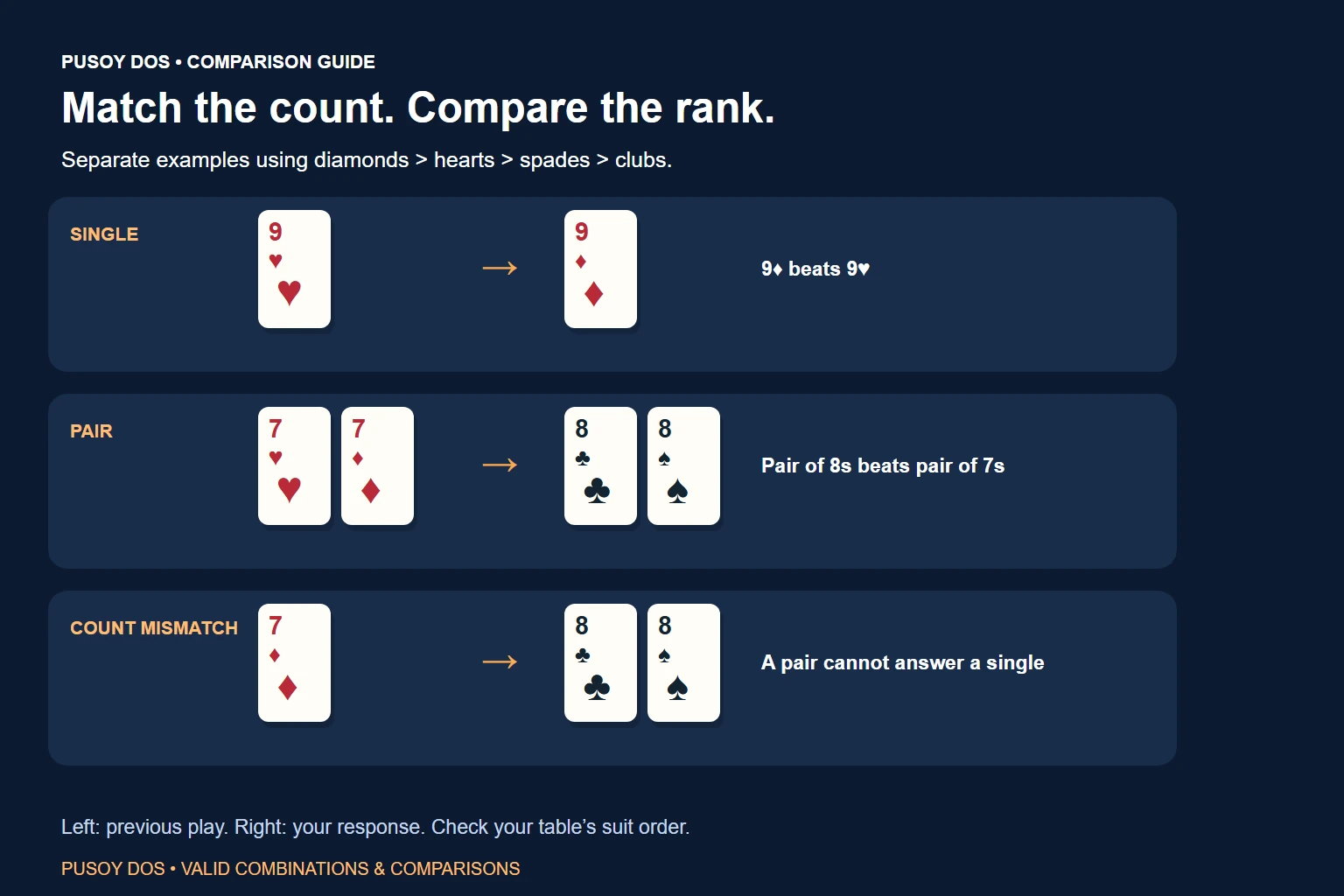
Can your cards beat the previous play in Pusoy Dos? Check three things in order: the number of cards, the type of combination, and the comparison rule. A high-looking card does not answer all three questions. Start with the examples below, then confirm the variations used at your table.
Quick answer: Match the required number of cards and make a stronger permitted response. This guide uses the Philippine suit order described below. It does not assume that every Big Two app uses identical rules.
Use three checks before comparing strength
First count. If the previous play is one card, placing a pair on it does not become valid just because both cards are higher. Next identify the combination. Finally apply the relevant comparison, instead of treating all attractive-looking groups as equivalent.
Try this method without a timer: write “count,” “combination,” and “comparison” on a sheet. For every practice response, explain all three. When an answer is unclear, you have found the specific rule to look up rather than a vague feeling that one hand looks better.
Recognize the combinations at a glance
Pagat’s Big Two reference describes singles, pairs, triples and five-card combinations. Its basic five-card ordering is straight, flush, full house, four of a kind with an extra card, then straight flush. It also documents variants, so confirm that your Pusoy Dos table allows this set of combinations.
| Practice example | What to identify |
|---|---|
| 8♣ 8♠ | Two cards of one rank: a pair |
| 6♣ 6♦ 6♥ | Three cards of one rank: a triple |
| 5♣ 6♦ 7♥ 8♠ 9♣ | Five consecutive ranks: a straight |
| 4♣ 4♦ 4♥ J♣ J♦ | A triple and a pair: a full house |
These examples deliberately avoid complicated edge cases. Learn to label an ordinary combination before working with an ace or two at the end of a sequence. If you cannot identify the combination, comparing it against another play is premature.
Can this play beat that one?
For Philippine Pusoy Dos, Pagat records suits from high to low as diamonds, hearts, spades and clubs. Rank runs from three low to two high, and the holder of 3♣ starts. Other Big Two versions can use another suit order.
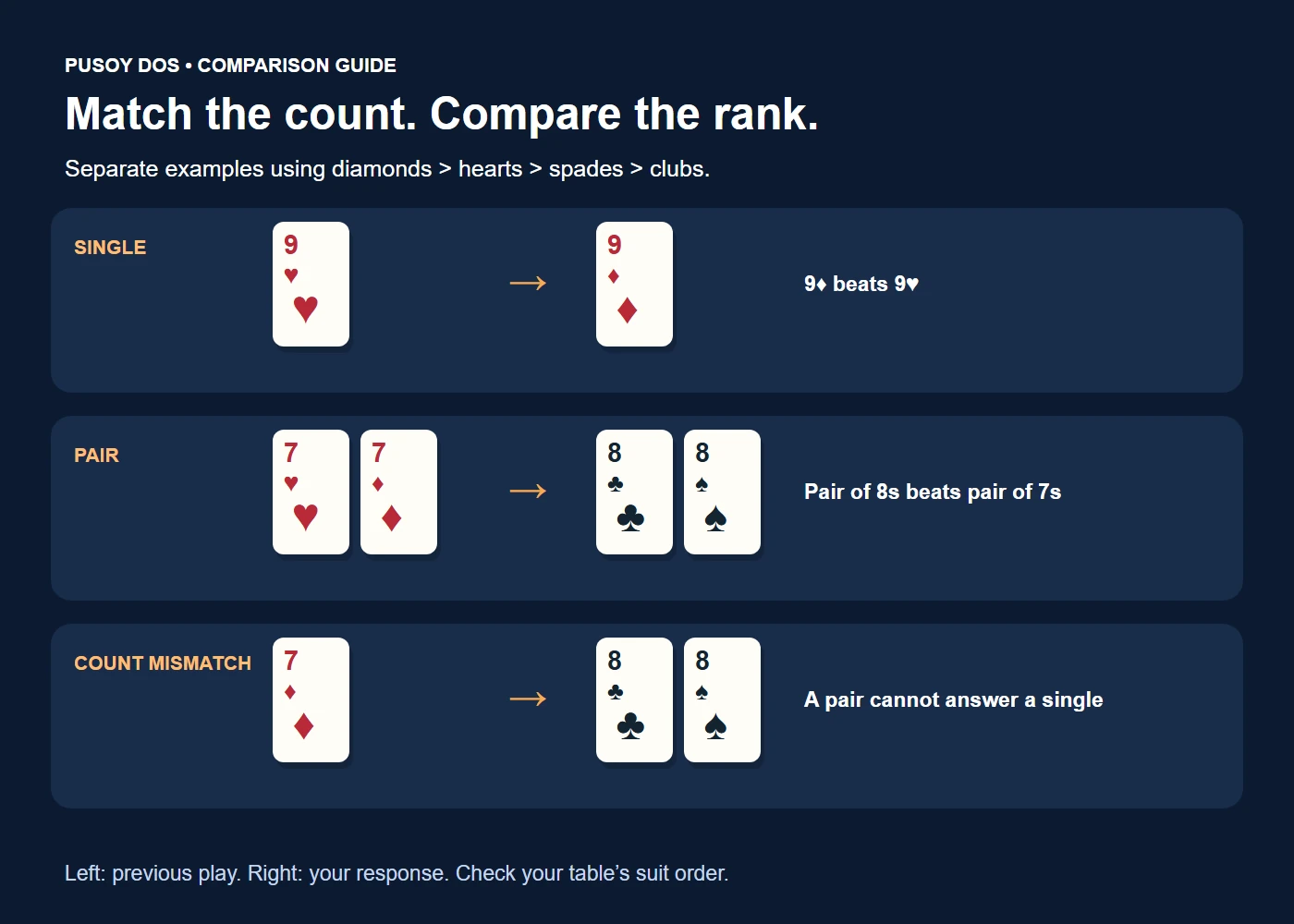
9♦ against 9♥: the count and rank match, so the stated suit order decides. Diamonds rank above hearts here. A guide using another order can give a conflicting answer without either picture revealing why.
8♣ 8♠ against 7♥ 7♦: both plays are pairs. The eights beat the sevens; the sevens do not become stronger because they contain a diamond. Check the ranks before you reach for a suit tiebreak.
8♣ 8♠ against a single 7♦: the first check fails. Two cards are not a single-card response. Stop there instead of spending time debating which individual card is higher.
Compare five-card hands carefully
Use the stated category order first; within a category, use its comparison rule. Pagat documents differences in flush comparisons and ace/two straights, as well as special combinations that some groups allow to interrupt other plays. Do not import those exceptions without agreement.
For a beginner exercise, compare 5♣ 6♦ 7♥ 8♠ 9♣ with 6♣ 7♦ 8♥ 9♠ 10♣ under an agreed ordinary highest-card straight rule. Both contain five consecutive ranks, and the second reaches ten rather than nine. State that assumption beside the exercise so the lesson is transparent.
A diagram should also distinguish a valid combination from a valid response. A full house may be a valid five-card hand while still being irrelevant to a single-card turn. That distinction prevents many misleading “strongest hand” charts.
Avoid three common reading mistakes
Do not confuse card rank with poker familiarity: a two has a different role here than in many other card games. Do not confuse suit importance with absolute strength: the pair example shows why a high suit does not rescue a lower pair. And do not assume a diagram uses your local rules merely because its title says Big Two.
Keep a short note of any unresolved rule. Ask a precise question such as “How does this table compare flushes?” rather than “Are these the normal rules?” A precise answer is easier to apply consistently.
Confirm the version before playing
Agree on allowed combinations, suit order, ace/two straights, flush comparisons, passing and starting procedure. This guide is a combination-reading aid, not a complete specification of every local variant.
If you intended to arrange thirteen cards into three separate hands, use our how to play Pusoy guide instead. For boundaries and support, see responsible gambling information.
Source note: Pagat’s Big Two rules and Philippine variations provide the reference framework. The comparisons and learning exercises are original; they do not establish a universal Pusoy Dos rulebook.
Sources checked: 6 October 2026. Educational rules guide; local and platform variations may differ.
Editorial methods and corrections