
GameZone Tongits Plus Strategy: Rules and Hand Reading
Understand Tongits strategy through valid melds, point counting and round awareness. A GameZone Tongits Plus guide with clear examples and version checks.
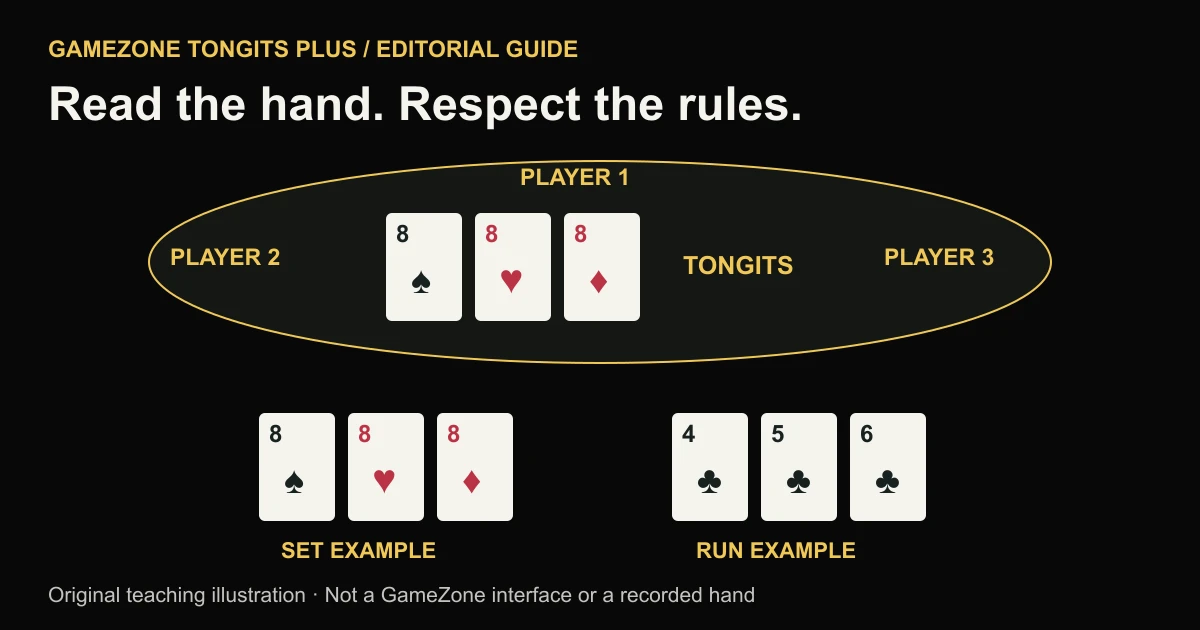
Understanding Tongits strategy starts with reading a hand correctly: which cards form valid groups, which cards remain unmatched, and what the current round allows. This guide uses GameZone Tongits Plus as its product focus and traditional Tongits as the reference for the card examples. It does not offer a guaranteed-win system or recommend stakes.
PAGCOR’s GameZone game list, dated 15 September 2026, identifies Tongits Plus and Tongits Quick as separate titles. Check the full name rather than applying every Tongits guide to every version. PAGCOR’s dated GameZone game list.
Reviewed on 2 October 2026. We examined the regulator’s list, public GameZone descriptions and a documented traditional rules reference. We did not enter a player round or test a withdrawal. The four images are original educational diagrams, not captures of the current GameZone interface.
Key Takeaways
- Check a group’s rank and suit before treating it as a valid meld.
- Count each physical card once, even if it could fit two different groups.
- Read the ending condition and eligibility rules before using a low point total to explain a result.
Identify Tongits Plus Before Applying a Guide
The regulator’s list places Tongits Plus under GameZone, operated by Total Gamezone Xtreme Incorporated, and classifies it as a specialty table game. The listing does not provide a full rulebook or prove the configuration of a room you are viewing today.
Use the title, room or mode label, and current help text as a matching set. A guide can explain common terms while still describing a different version. Do not shorten Tongits Plus, Tongits Quick and other similarly named products to one assumed ruleset.
For the broader platform context, see our GameZone consumer guide. This article focuses on card understanding and the information needed to interpret a Tongits round.
The Traditional Rules Behind the Examples
Pagat’s collected Tong-Its rules describe a three-player game using 52 cards without jokers. The dealer receives 13 cards and the others 12 each. The opening turn ends with a discard; later turns involve taking a card, optional grouping or laying off, and discarding.
A set contains three or four equal ranks. A run contains at least three consecutive cards of one suit. One card cannot belong to two groups at once. Sapaw means adding cards to an existing exposed group.
That reference describes three endings: Tongit, exhaustion of the stock, or a called Draw. An opened hand and other conditions affect eligibility for a comparison. These traditional rules are context, not a substitute for the current Tongits Plus room rules.
GameZone’s traditional Tongits introduction gives the familiar card values: Ace is 1; Jacks, Queens and Kings are 10; numbered cards retain their face value. The examples below use that scoring convention.
Read a Hand by Testing Each Group
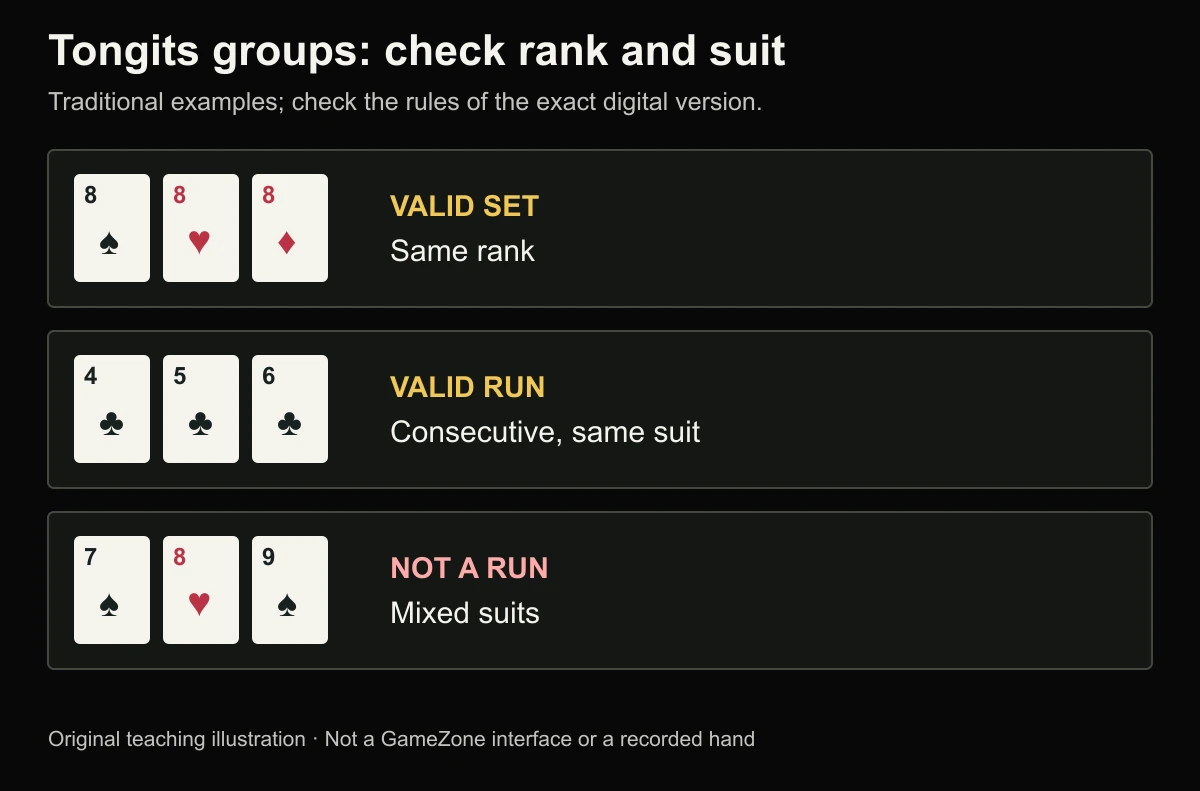
Before thinking about a result, describe the cards accurately. Is the grouping based on equal ranks or on a sequence within one suit? A useful exercise is to write the reason a group qualifies, rather than marking it valid because the cards look similar.
| Illustrative cards | Reading | Reason |
|---|---|---|
| 8♠, 8♥, 8♦ | Set | Three cards share the rank 8 |
| 4♣, 5♣, 6♣ | Run | Consecutive ranks, all clubs |
| 7♠, 8♥, 9♠ | Not a run | The heart breaks the same-suit requirement |
| 4♣, 6♣, 7♣ | Not a run | The ranks contain a gap |
These are separate examples, not a complete dealt hand or a recorded game. A row marked valid explains its grouping only. It does not establish when a particular online room allows that group to be exposed or how the room settles the round.
One card cannot do two jobs at once
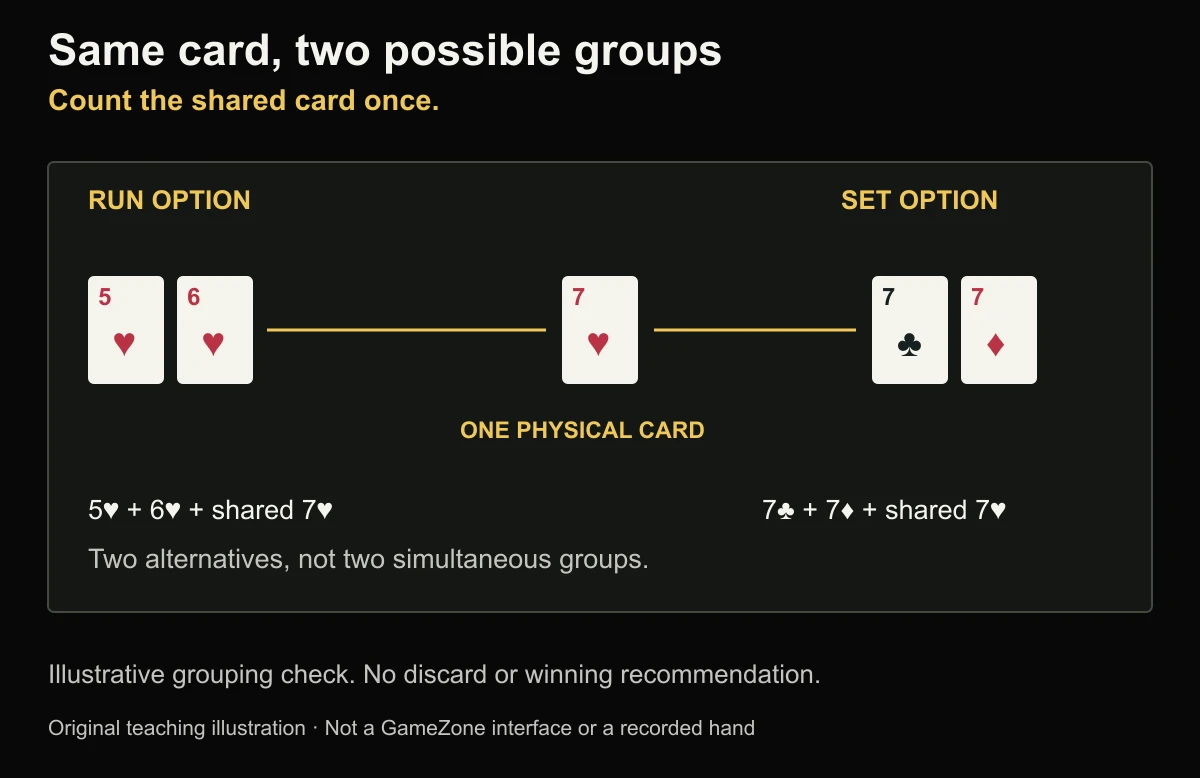
Consider these five cards: 5♥, 6♥, 7♥, 7♣, 7♦. The 7♥ could belong to the heart run or the set of sevens. It cannot complete both simultaneously.
This is a counting exercise, not a recommendation to choose one arrangement. Its purpose is to expose a common mistake: adding up all the groups a hand could form as though they already existed together. When reviewing a hand, name the chosen grouping and list the cards left outside it.
Count Unmatched Points Without Declaring a Winner
Suppose a teaching example leaves Q♠, 8♦ and 3♣ unmatched. Their total is 10 + 8 + 3 = 21. A separate example with 9♥, 7♣ and 6♦ totals 22. Both contain three cards, but their point totals differ.
The comparison teaches arithmetic only. It does not describe competing hands in an actual game, establish eligibility, or tell you that the lower figure must win. A correct count answers one question: “What is the value of these unmatched cards under this scoring convention?”
Keep a simple worksheet when checking a diagram or a saved hand:
- List every card once.
- Mark the groups being counted as valid.
- Write the remaining cards separately.
- Add their values, then check the applicable ending rule.
Separating those steps makes errors easier to find. If the result differs from your expectation, you can ask whether the disagreement concerns grouping, arithmetic, eligibility or the ending itself.
Understand the Round State and the Word “Draw”
In this reference, calling Draw starts a possible hand comparison; it is distinct from taking a card. Eligibility restrictions apply. See the traditional ending rules.
For an online version, read the current help text before assigning meaning to a button or message. A disabled control may reflect the rules or the current turn, but its appearance alone does not tell you which condition applies. Record the message exactly instead of guessing.
The diagram below is an editorial reading sequence. It does not recreate GameZone’s controls or promise that every step appears in the same order on screen.
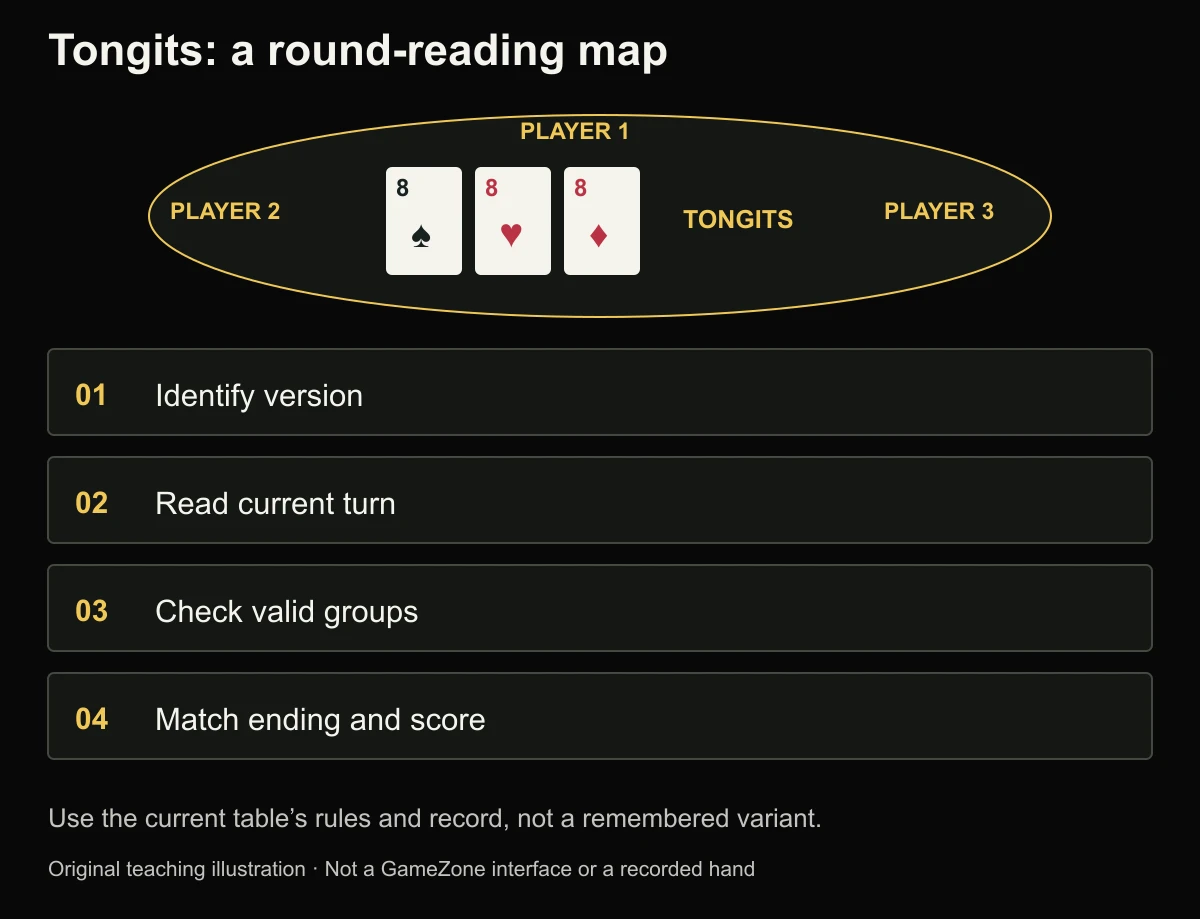
When a round ends, keep its stated reason with the score. “Lowest points,” “Tongit,” and a challenge result should not be silently treated as the same event. If a special status such as sunog appears, find its definition in the room rules before interpreting any penalty or exclusion.
Separate Visible Information from Assumptions
A useful reading habit is to label what you know and what you infer. The table below is an analytical framework, not a prediction system.
| Information | What you can reasonably record | What it does not establish |
|---|---|---|
| Your visible cards | The ranks and suits actually shown | The contents of another hand |
| An exposed group | Its displayed cards and current arrangement | Every card its owner still holds |
| A visible discard | That card’s appearance at that point in the record | A complete explanation of the player’s intent |
| A final score | The number shown for that result | Whether your own reading of eligibility was correct |
For example, seeing someone discard a heart does not reveal their entire hand. A claim about their intention needs more than the suit of one card. Keep such interpretations separate from the observable record when reviewing a game or discussing it with support.
This is where an educational “strategy” guide can be useful without promising an outcome: it improves the quality of the questions you ask about the cards and rules.
Common Mistakes in Tongits Guides and Hand Reviews
Mixing suits in a run. Consecutive numbers can distract from the suit symbols. Read both parts of each card in the example.
Counting an overlapping card twice. A possible run and a possible set may compete for the same card. Draw the physical card once and show the two possible groupings separately.
Confusing card count with point count. “Three cards left” is not a point total. The worked examples above show why the distinction matters.
Treating a low total as the whole result. Ask how the round ended and whether the relevant hand qualified for comparison.
Applying the wrong version’s rules. A screenshot with a shortened title may omit the detail that explains a different rule. Keep the full product and mode name with the record.
What to Check in the Current Tongits Plus Room
GameZone’s public Tongits Plus product introduction describes digital controls and automatic scoring. Those are operator descriptions; this review did not test their operation.
Before using any guide to explain a specific result, record the full title, mode, help or rule version if shown, and the round identifier. Then check the definitions of available actions, how the room handles ending conditions, and what the displayed score includes.
If the record does not explain a result, send the precise question through the platform’s verified support channel. Redact unrelated account or payment information. For account issues outside the card rules, our KYC and withdrawal problem guide covers a separate set of checks.
Tongits Strategy Questions
Does a valid meld mean the hand wins?
No. It establishes that the illustrated cards meet a grouping rule. The complete hand, round ending and applicable conditions still need to be considered.
Are Tongits Plus and Tongits Quick interchangeable?
Do not assume so. The dated regulator list identifies separate titles. Match the exact product and its own help text before applying a rule from another guide.
Does this guide provide a guaranteed winning strategy?
No. It explains card reading and common errors, using labelled examples. It does not validate prediction tools, guarantee results or recommend a way to recover losses.
Review Method and Further Reading
We separated product identity from traditional rules, used original card examples, and left untested room settings unconfirmed. Pagat documents a traditional version; the GameZone articles are public introductions, not a complete current in-room rulebook. A dated game listing is not a blanket endorsement of every website or app using the product’s name.
Our editorial policy explains sourcing and corrections. Our responsible gambling guide provides information about limits and support.
Editorial methods and corrections