
Online Slots in the Philippines: 4 Games Compared
Compare Fortune Gems, Super Ace, Sweet Bonanza and Mahjong Ways 2 through official examples. Understand paylines, ways, RTP, volatility and game versions.
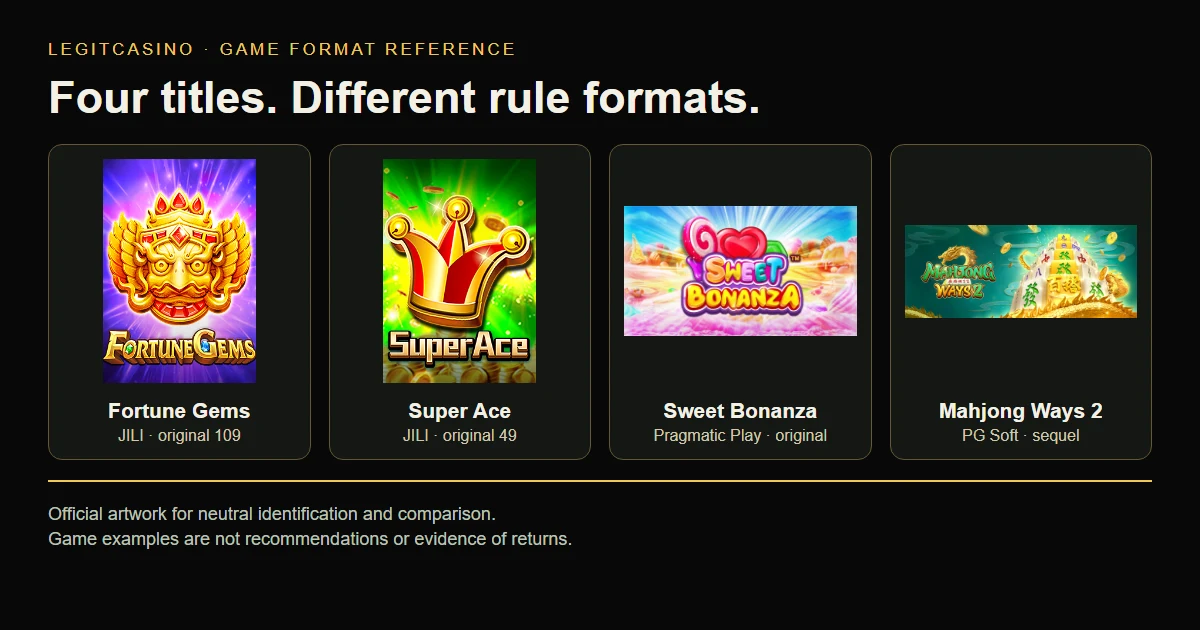
An online slot can use fixed paylines, ways or matching symbols anywhere on a grid. Those labels describe how the game evaluates symbols; they do not tell you how likely a person is to profit. Fortune Gems, Super Ace, Sweet Bonanza and Mahjong Ways 2 provide four concrete cases for understanding the differences.
This guide is written for readers in the Philippines who want to understand game descriptions. It compares published rules and manufacturer examples, without ranking the games or directing readers to a casino. Inclusion does not establish current availability or authorisation on a Philippine platform.
Sources checked: 3 October 2026. Images are manufacturer-supplied references with separate editorial labels. We did not conduct paid gameplay or test deposits and withdrawals.
Key Takeaways
- Identify the exact title and provider before comparing rules.
- Paylines, ways and symbol counts measure different things.
- RTP describes a statistical return, while a multiplier modifies a particular calculation.
- Theme, screenshot and brand recognition cannot verify an operator.
Four Cases at a Glance
| Exact game | Provider | Published rule reference | What this case illustrates |
|---|---|---|---|
| Fortune Gems, original | JILI | 5 lines; multiplier feature | A line count is part of the evaluation structure. |
| Super Ace, original | JILI | 1,024 ways | Ways should not be read as a count of guaranteed wins. |
| Sweet Bonanza, original | Pragmatic Play | Matching symbols anywhere; tumbles | Symbol location and symbol quantity are separate concepts. |
| Mahjong Ways 2 | PG SOFT | 2,000 ways | A familiar table-game theme can be used in a slot. |
The official references supporting these entries appear beside each case below. Read across the columns, rather than treating the largest number as the strongest game. A count of lines and a count of ways are not a shared performance score. The table also deliberately keeps provider and title separate: several games can share a developer without sharing their rules.
A small counting example helps: choosing one position from each of three columns, each containing two positions, produces 2 × 2 × 2 = 8 possible combinations. The grid still has only six positions. That arithmetic explains how a combination count can exceed the size of a screen; it does not say that every combination qualifies for a payment. The game’s matching conditions remain a separate rule.
Fortune Gems: A Five-Line Example
JILI’s original Fortune Gems listing, product 109, identifies a slot with five lines and a multiplier feature. This is the original title, not Fortune Gems 2 or a later numbered version.
For this case, focus on what a line label is telling you. It describes a defined path used to evaluate symbols. It is not the number of spins, the number of symbols on the screen or a percentage return. The supplied image is useful for locating the game identity and seeing how the interface separates the symbol area from other information.
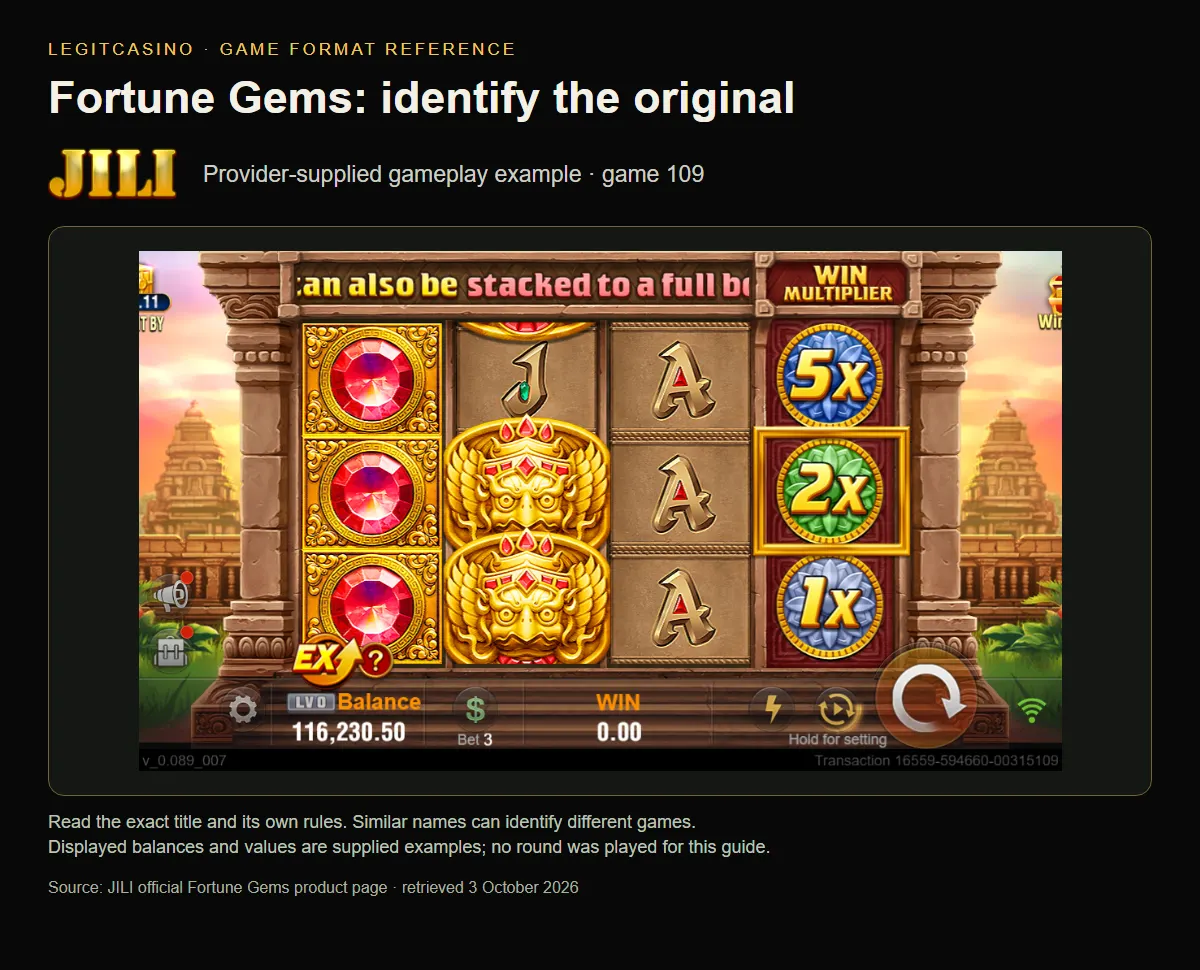
A rules comparison should record the line definition separately from the multiplier. Otherwise, two unlike values can accidentally end up in one column called “payout”. That shortcut loses the distinction the reader needs to understand the screen.
Super Ace: A Ways-Based Example
JILI’s Super Ace listing, product 49, specifies 1,024 ways and lists Free Game, Free Spin and Multiplier features. Its description also distinguishes Golden Card and Golden Joker states.
The useful comparison here is the unit. “1,024 ways” is a structural rule label, whereas “five lines” uses a different counting method. Dividing one number by the other would not produce a meaningful probability advantage. Neither number alone supplies symbol frequencies, the complete paytable or the distribution of possible returns.
Super Ace also shows why a static image needs context: a symbol’s appearance and role may be associated with a particular feature state. Our Super Ace symbols and Scatter guide explains the original game’s supplied screens in more detail. This comparison keeps the overview short so the specialist article remains the place for that material.
Sweet Bonanza: Matching Symbols Anywhere
The reference is Pragmatic Play’s original Sweet Bonanza page. Its description uses matching-symbol quantities anywhere on the grid and a tumbling sequence, rather than a fixed line pattern. It also describes a separate Scatter-triggered feature. Sweet Bonanza 1000 is a different title and is outside this case.
“Anywhere” concerns location; it does not remove the required symbol quantity. The official page starts its matching-symbol groups at eight. Nor does it mean that touching symbols necessarily form a cluster. A tumble describes the progression of a sequence, while the matching rule describes which symbols qualify. Keeping these two ideas separate makes comparisons clearer.
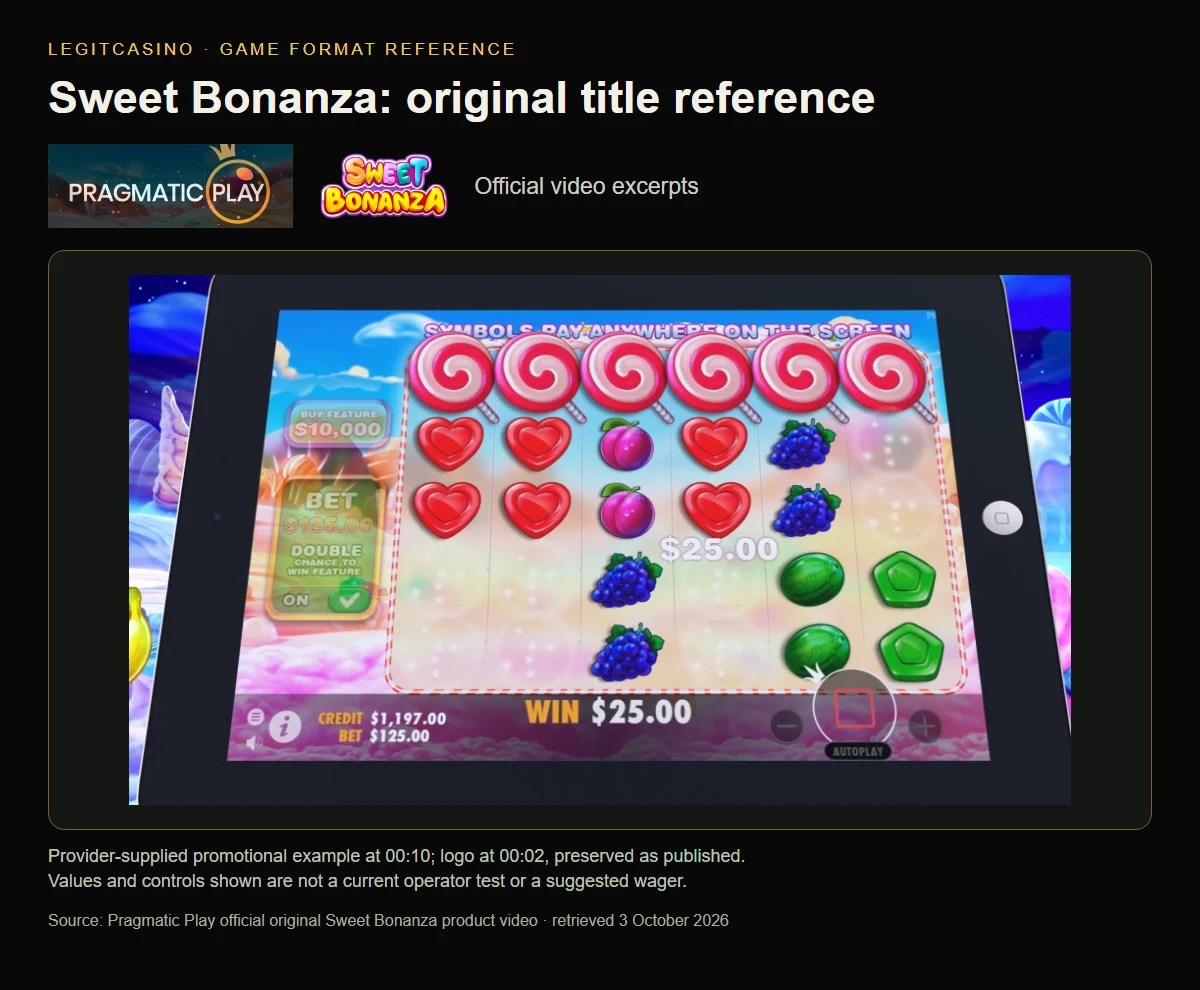
An animation may make several events look like one continuous result. To interpret the example, the important distinction is between the sequence currently shown and a cumulative display, not the colour or size of its presentation.
Mahjong Ways 2: Theme and Game Type
The indexed official Mahjong Ways 2 game-information document identifies its 2,000-way structure. PG SOFT’s sequel announcement identifies the product as a video slot. The mahjong imagery establishes its theme; it should not be mistaken for a conventional multiplayer mahjong table.
This is a useful classification case. Artwork can resemble a card or tile game while the underlying product uses slot rules. A reader searching for a table game therefore needs more than a familiar-looking tile to establish that the page answers the right question.
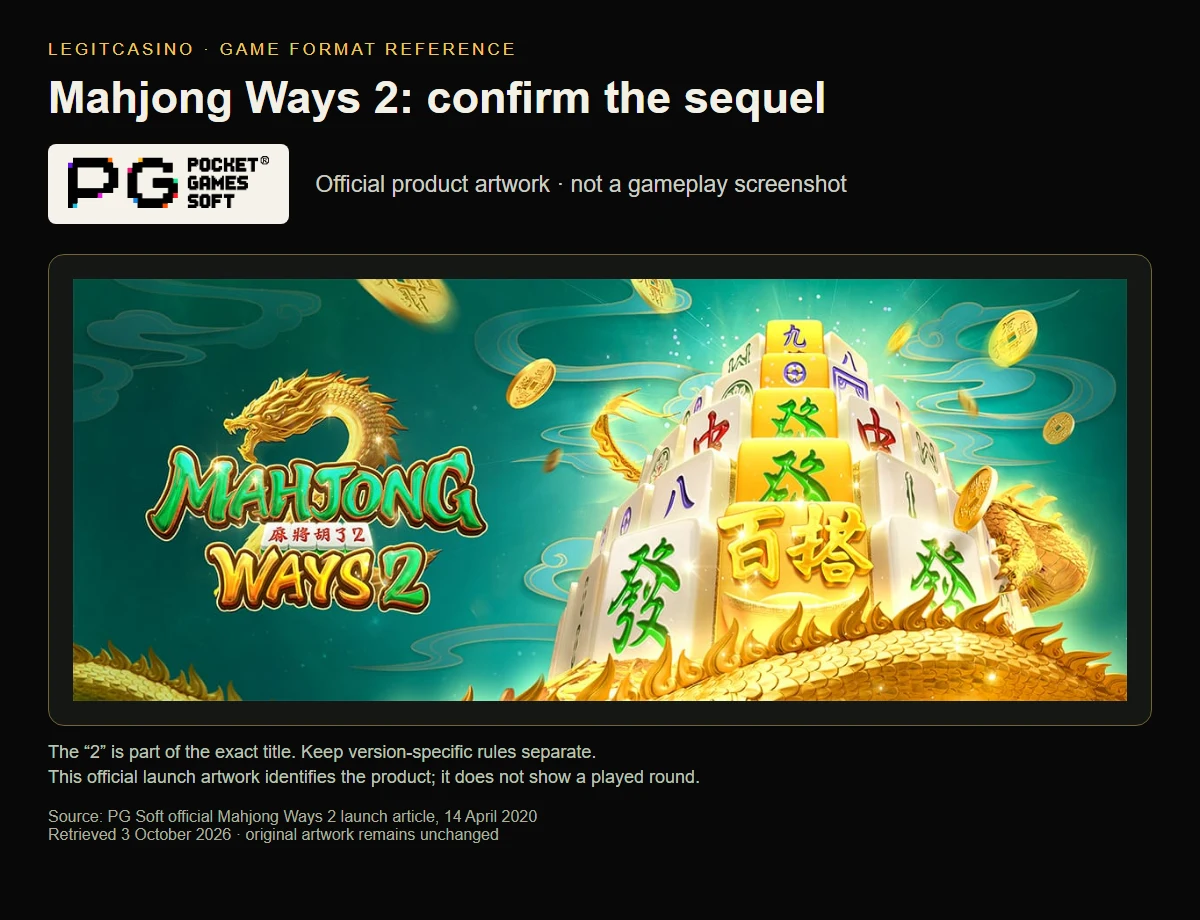
For classification, write down “slot” before describing the theme. That prevents a comparison from mixing a reel-based product with a game whose central interaction is between seated players. Our table-game overview addresses that broader category distinction.
RTP, Volatility and Multipliers Answer Different Questions
The UK Gambling Commission’s RTP monitoring guidance distinguishes theoretical RTP, designed into a game, from actual RTP measured over a period. Actual RTP is total returned winnings divided by turnover. The same guidance explains why sample size and volatility matter when interpreting the difference. It is cited here for statistical concepts, not as Philippine licensing evidence.
For a purely hypothetical illustration, 9,600 units returned across 10,000 units of turnover gives an actual RTP of 96%. That aggregate calculation says nothing about one person’s next result. Turnover is the sum of stakes in the measured sample, not automatically the amount initially deposited. Volatility concerns variation in outcomes; a simple low/medium/high label is not a guarantee about an individual session. We have not tested the configurations of these four titles and do not assign them a comparable RTP ranking.
Other labels need their own definitions:
| Label | Question it answers | A common reading error |
|---|---|---|
| Line or ways count | What evaluation structure is described? | Treating the count as a percentage chance. |
| Multiplier | Which specified amount is multiplied? | Assuming every displayed amount receives it. |
| Feature counter | What quantity remains or has accumulated? | Reading a count as currency. |
| Maximum result | What upper outcome does the stated rule allow? | Treating a possible ceiling as a typical return. |
Consider the notation “3x” in isolation. It has no complete monetary meaning until the underlying amount is named. Three times 10 units is 30 units, but that arithmetic does not establish whether the interface means a symbol award, a sequence total or another defined value. This is a unit-reading example, not a rule attributed to any of the four games.
The same care applies to a screenshot containing “100”. Without its label, the number might be a balance, a counter or an amount in credits. A comparison that copies the number but omits the unit adds apparent precision while losing meaning.
How to Read a Game Description Consistently
Use the same small record for each source: full title, provider, document date, rule category, named feature and the unit attached to each number. This is a documentation exercise; it does not require placing a bet or opening an account.
Start with identity. A sequel number, suffix or different provider can invalidate a screenshot match before any mathematical comparison begins. Then separate the basic matching rule from later feature behaviour. Finally, distinguish what the document states from what an illustration merely shows.
For example, a supplied screenshot can establish that a particular label appears in an example interface. By itself, it cannot establish how often that screen appears, whether the same configuration is deployed elsewhere, or whether the depicted return is typical. A document containing a feature description provides a different kind of evidence from an isolated image.
When a detail is missing, record it as unverified. Do not fill the gap using a similarly named game or a review of another version. This keeps the comparison useful even when the source material is incomplete.
Sources, Images and Review Limits
This article uses developer publications and public reference material, checked on the date above. Official logos identify the manufacturers; they are not seals of approval for LEGITCASINO or any third-party platform. The original artwork and screenshots belong to their respective owners. Our captions and layout are editorial additions, and the developers have not endorsed this article.
We did not verify a live Philippine operator catalogue, measure return rates or compare platform services. The four cases were chosen to explain different reading problems, not to establish a popularity order. Source pages and delivered game versions can change, so the precise title remains part of every comparison.
Some source pages were readable through web extraction when direct requests failed. The PG document’s title and ways count were checked against indexed official text; its full PDF could not be independently opened during this review. We therefore omit detailed PDF-only feature rules. No certificate warning or access restriction was bypassed.
If gambling is causing distress or financial pressure, our responsible-gambling information covers support-oriented next steps. Understanding a rule or a statistic does not remove the possibility of losing money.
Editorial methods and corrections