
How to Play Pusoy: Organize Your Cards and Check Your Hands
Learn how to organize a Pusoy hand, inspect a complete thirteen-card example, and catch invalid arrangements before confusing them with winning strategy.
Not sure how to play Pusoy when thirteen cards are staring back at you? Start by finding combinations, try a three-hand arrangement, and check the order before submitting it. The goal of your first practice hand is a valid layout you can explain—not a supposedly perfect arrangement that you copied without understanding.
Quick answer: Identify your combinations, allocate every card once, then compare the three hands. This guide covers classic closed-hand Pusoy, also called Chinese poker, rather than Pusoy Dos or an open-face variant.
Start with a simple hand-setting checklist
Use three passes instead of repeatedly moving cards at random. First, group matching ranks and look for possible five-card combinations. Next, sketch one complete layout. Finally, check the weaker hands as carefully as the strongest one. A striking combination is only one part of the arrangement.
For a first exercise, place the cards on paper or an ordinary table without stakes. Record the layout before changing anything. This lets you compare two arrangements without accidentally forgetting a card or using it twice. Label your rows with words rather than relying on which side of a screen they occupy.
Follow one complete thirteen-card example
Here is an original practice arrangement. It illustrates a valid layout, not a claim about the strongest possible play against unknown opponents.
| Hand | Cards | Combination |
|---|---|---|
| Front | 2♣ 2♦ 9♠ | Pair of twos |
| Middle | 7♣ 7♦ K♣ Q♦ J♠ | Pair of sevens |
| Back | A♥ K♥ Q♥ J♥ 10♥ | Royal flush |
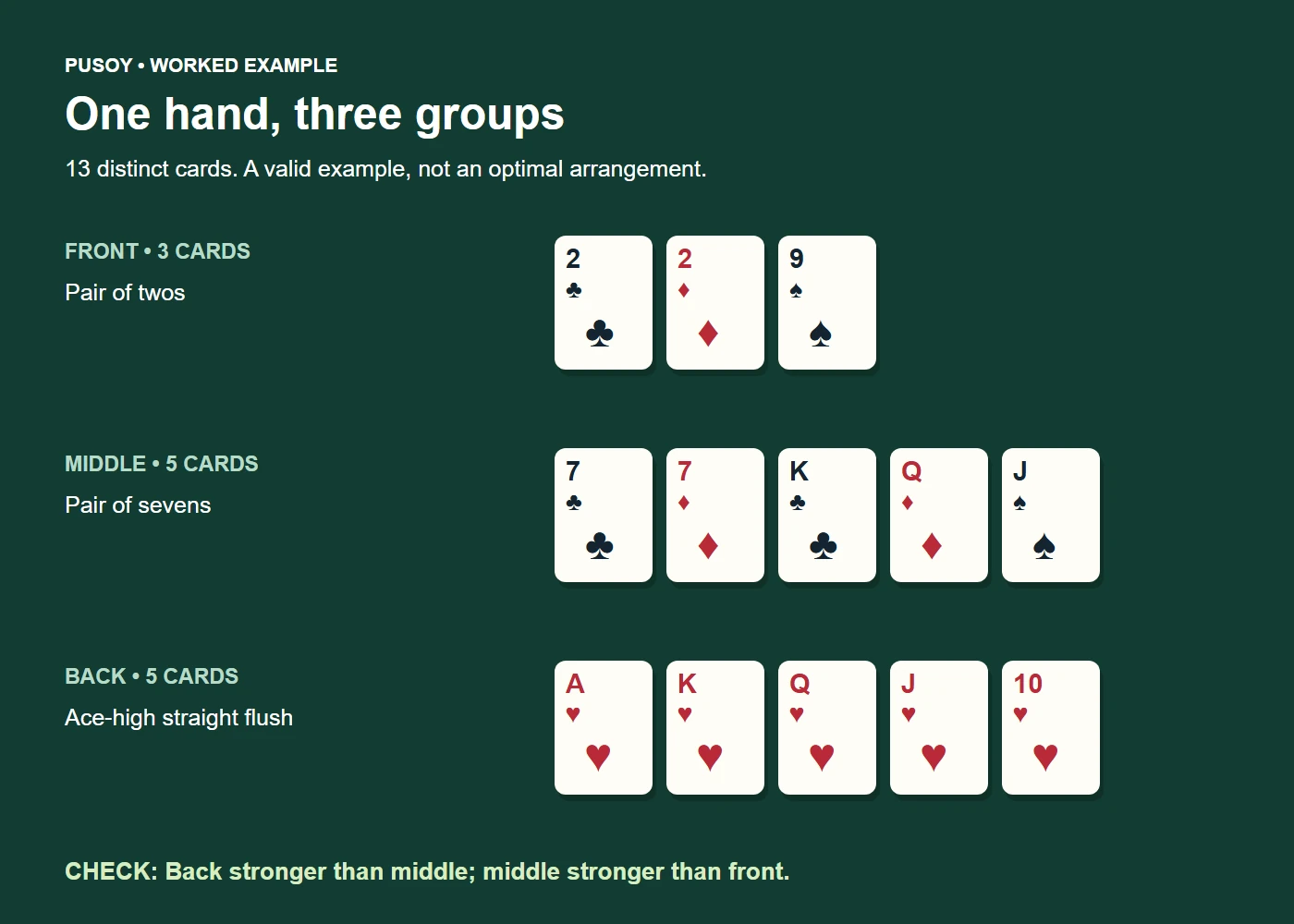
Count the cards before comparing them: three plus five plus five equals thirteen. Then check identity, not just rank. K♣ and K♥ are different cards; two copies of K♥ would be an error in a single-deck example. Finally, read the combinations aloud: pair of twos, pair of sevens, royal flush.
This exercise gives you a repeatable way to inspect your own layout. If you change a card, repeat the count and comparison. Do not assume that an arrangement remains valid because only one pair moved.
Understand the rule behind the arrangement
In the classic rules documented by Pagat’s Chinese Poker guide, thirteen cards form a three-card front and five-card middle and back. The back must outrank the middle, which must outrank the front. The front recognizes high card, a pair, or three of a kind; three same-suit or consecutive cards do not form an ordinary front-hand flush or straight.
Apply that rule to the example rather than memorizing the picture. The middle pair outranks the front pair, and the back combination outranks both. The explanation is what makes the exercise useful: you could replace the example with different cards and run the same check.
Spot an invalid arrangement before submitting
Now swap the two pairs. Put 7♣ 7♦ beside 9♠ in front, and place 2♣ 2♦ with K♣ Q♦ J♠ in the middle. You still have thirteen different cards. You still have three rows of the correct size. But the front pair of sevens now outranks the middle pair of twos.
This is why a card-count check alone is insufficient. A useful checklist has separate boxes for “correct number,” “no duplicate card,” and “correct order.” If you cannot explain a comparison, pause and consult the applicable hand rankings rather than trusting the appearance of the layout.
Separate a valid layout from the scoring system
At showdown, corresponding positions are compared between players. Pagat describes a simple per-hand scoring system alongside optional bonuses and special thirteen-card holdings. Agree on the scoring version and invalid-hand treatment before play; this example does not assume bonus payments.
A valid layout and a winning layout answer different questions. The first asks whether you followed the construction rules. The second depends on the other hands and the agreed scoring. An illustration cannot establish those unknowns. Keep practice focused on explaining comparisons before adding unfamiliar scoring exceptions.
Make sure you opened the right game
If the game asks you to beat the last cards played and empty your hand, you may be looking for Pusoy Dos combinations instead. Check the full game name before applying a tutorial. Similar names do not make the table layouts or objectives interchangeable.
Before a session, ask which rules govern scoring, special hands and invalid arrangements. Treat an unclear answer as a reason to clarify the rules, not to improvise them. For general limits and support information, see our responsible gambling guide.
Source note: The rule reference is Pagat’s independently compiled Chinese Poker rules. The card layout and checking exercises above are original educational examples. Local and platform variants may differ.
Sources checked: 6 October 2026. Educational rules guide; local and platform variations may differ.
Editorial methods and corrections