
Tongits Rules: What to Do When It’s Your Turn
Follow a clear Tongits turn example, understand when a discard can be taken, and distinguish ordinary card draws from a Draw call.
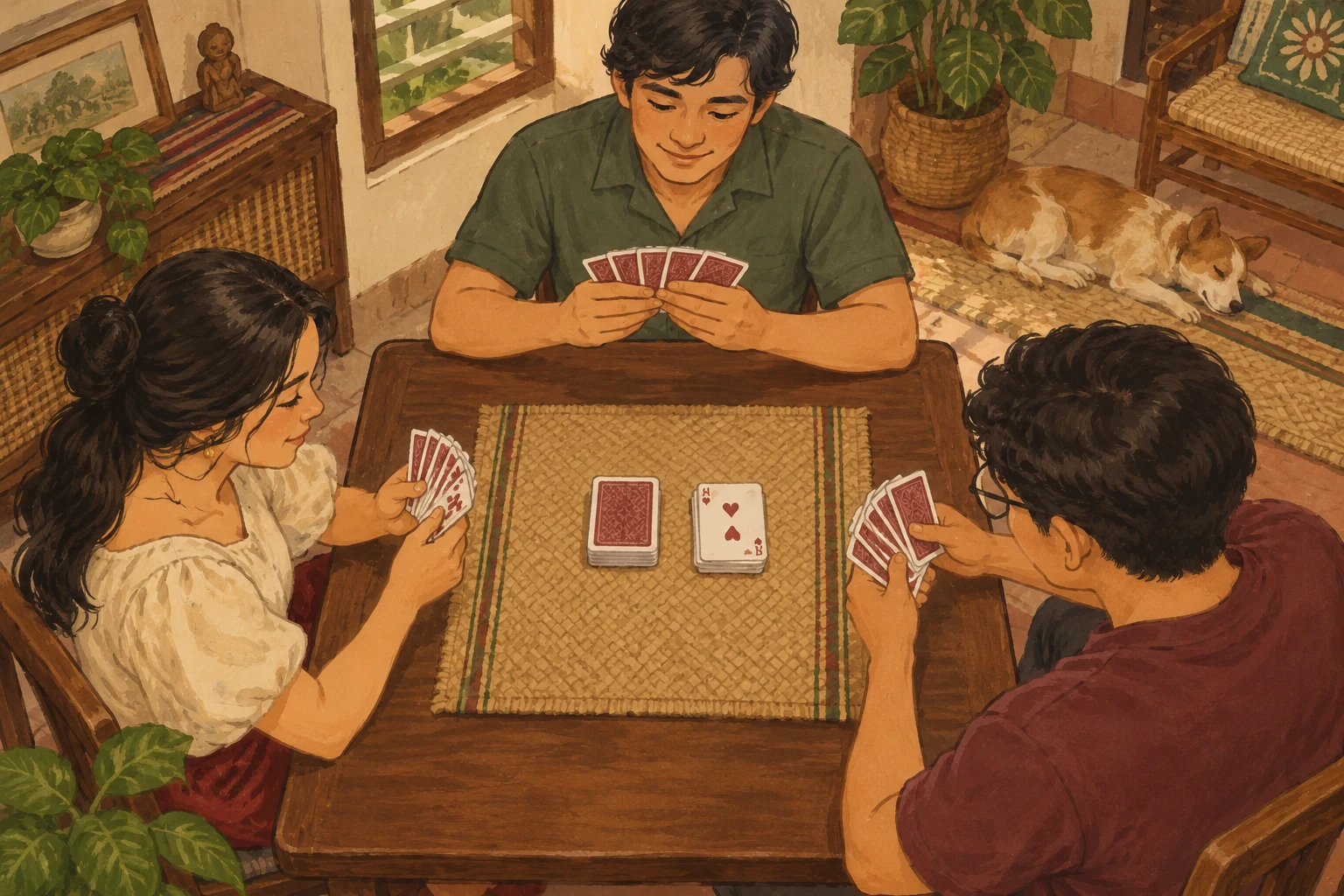
Getting stuck when it is your turn in Tongits? Separate the decision into three questions: where can I take a card, which actions are allowed, and how does this turn finish? Start with the short example below. It is easier to understand a legal move before memorizing every term used around the table.
Quick answer: For an ordinary turn, take a permitted card, consider valid melds or additions, and finish with a discard unless an ending condition applies. The dealer’s opening turn is different. These Tongits rules follow the documented version linked below, not every app’s settings.
Use a checklist rather than guessing
Before touching the discard pile, ask what you intend to do with its top card. A card that looks useful is not necessarily available for any purpose you choose. Keep “I want this card” separate from “the rules let me take this card.”
Then distinguish a required action from an optional one. A tutorial can become misleading when its arrows imply that every player must expose a combination on every turn. If you are learning with physical cards, say your intended action aloud and check the relevant rule before moving the card.
Walk through one small example
Suppose the relevant cards in your hand are 7♥ and 8♥, and 9♥ is the top discard. Under the rules used here, you can take 9♥ to expose the new run 7♥ 8♥ 9♥. If the round continues, you can then discard another card, such as K♣, to finish the turn.
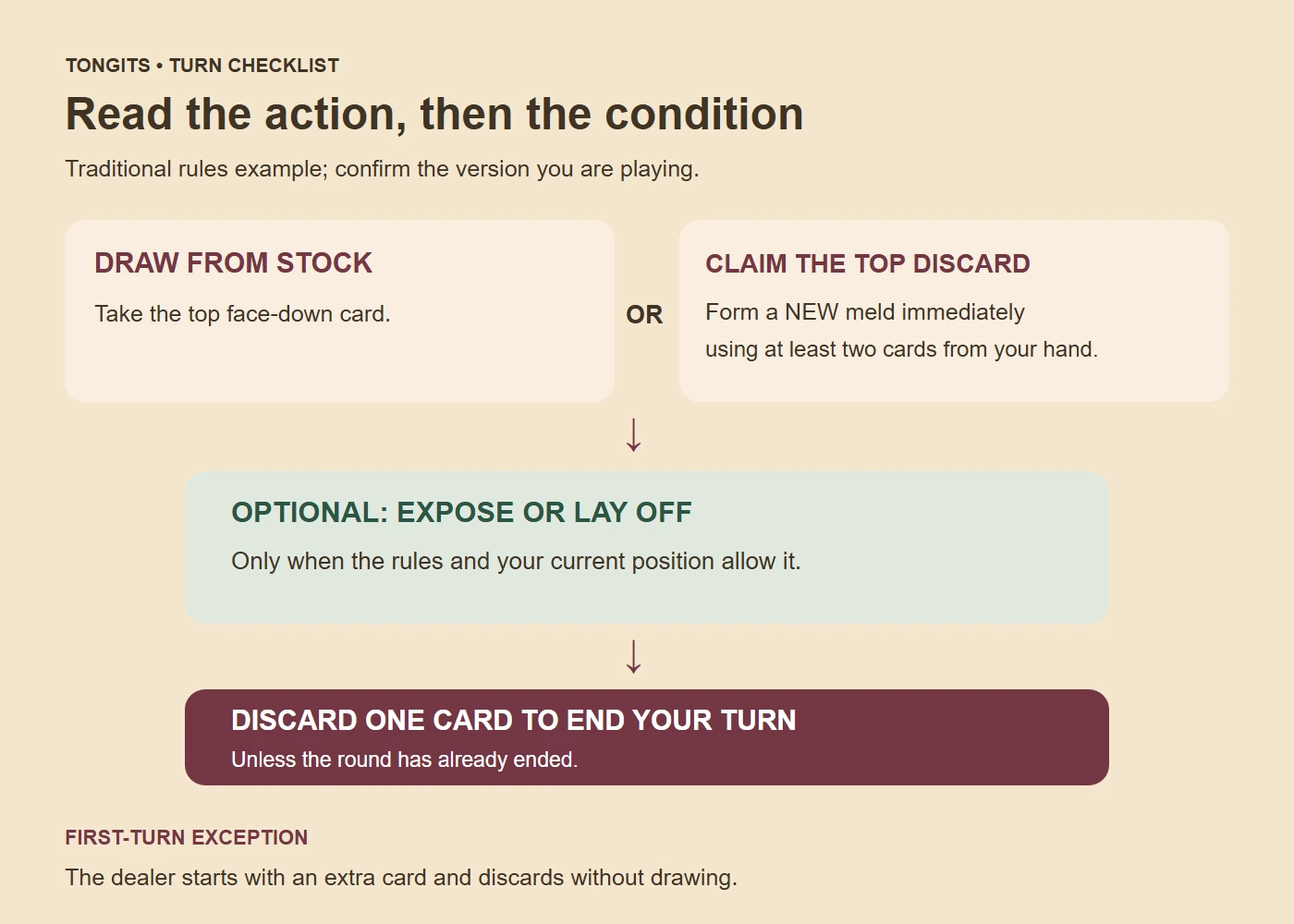
The example is about legality, not the best discard. K♣ makes the sequence easy to follow, but choosing it in a real position would require information that this partial example does not provide. Do not read a teaching diagram as a recommendation to discard every high card.
Try explaining what changes: 9♥ leaves the discard pile; the three hearts become an exposed combination; K♣ becomes the new top discard. Keeping track of location is as important as recognizing the pattern.
Know the conditions attached to each action
Under Pagat’s Tong Its rules, take the top stock card or an eligible discard. The latter must create an exposed meld with at least two hand cards, not extend an existing meld. After stock draws, exposing melds is optional. Sapaw extends exposed melds. Discard to finish a continuing turn.
Compare two questions before acting: “Am I making a new combination?” and “Am I adding to one already on the table?” They may look similar in a picture, but they are different actions. This distinction is especially useful when following a video that moves too quickly to explain its assumptions.
Read the terms without mixing them up
Sets contain three or four equal ranks; runs contain at least three consecutive same-suit cards. Aces are low, worth one; picture cards count ten; others count face value. One card cannot serve two combinations.
“Draw a card” describes taking a card. “Call Draw” describes a different, conditional request to compare hands. When reading a rules screen, look for which meaning is intended rather than relying on capitalization alone.
For practice, write a small glossary beside your table: set, run, exposed meld, sapaw, unmatched cards. Add one card example next to each. A glossary built from concrete examples is more useful than memorizing translated labels without understanding the action.
Check how the round ends
Endings include Tongit, stock exhaustion after the final taker’s turn, and Draw. Opening and recent laying-off actions affect Draw eligibility. Check the linked rules for contest eligibility, ties and sunog penalties.
Do not stop the round merely because someone has a small hand. Equally, do not assume that a low unmatched-card total automatically overrides every eligibility rule. When learning, pause at the proposed ending and name the ending condition first. Only then work through who may participate in the comparison.
Set up a practice game and choose your next guide
Use three players and 52 cards: thirteen for the dealer, twelve for each opponent, remainder as stock. The dealer begins by discarding, without drawing. Play proceeds counterclockwise.
Use a no-stakes practice round to test the sequence. If your app or group uses different settings, write them down before beginning; do not combine instructions from incompatible versions midway through a round.
Our Tongits overview provides further context. Once the actions are familiar, the Tongits strategy guide discusses decisions beyond the basic sequence. Keep learning separate from expectations of profit; support and limits are covered in our responsible gambling guide.
Source note: Pagat is an independent rules reference, not a universal app rulebook. The partial turn example and practice exercises are original.
Sources checked: 6 October 2026. Educational rules guide; local and platform variations may differ.
Editorial methods and corrections