
RTP Meaning: House Edge, Volatility and Common Myths
Understand what RTP means, how house edge differs from volatility, and why a payout percentage cannot predict your next result.
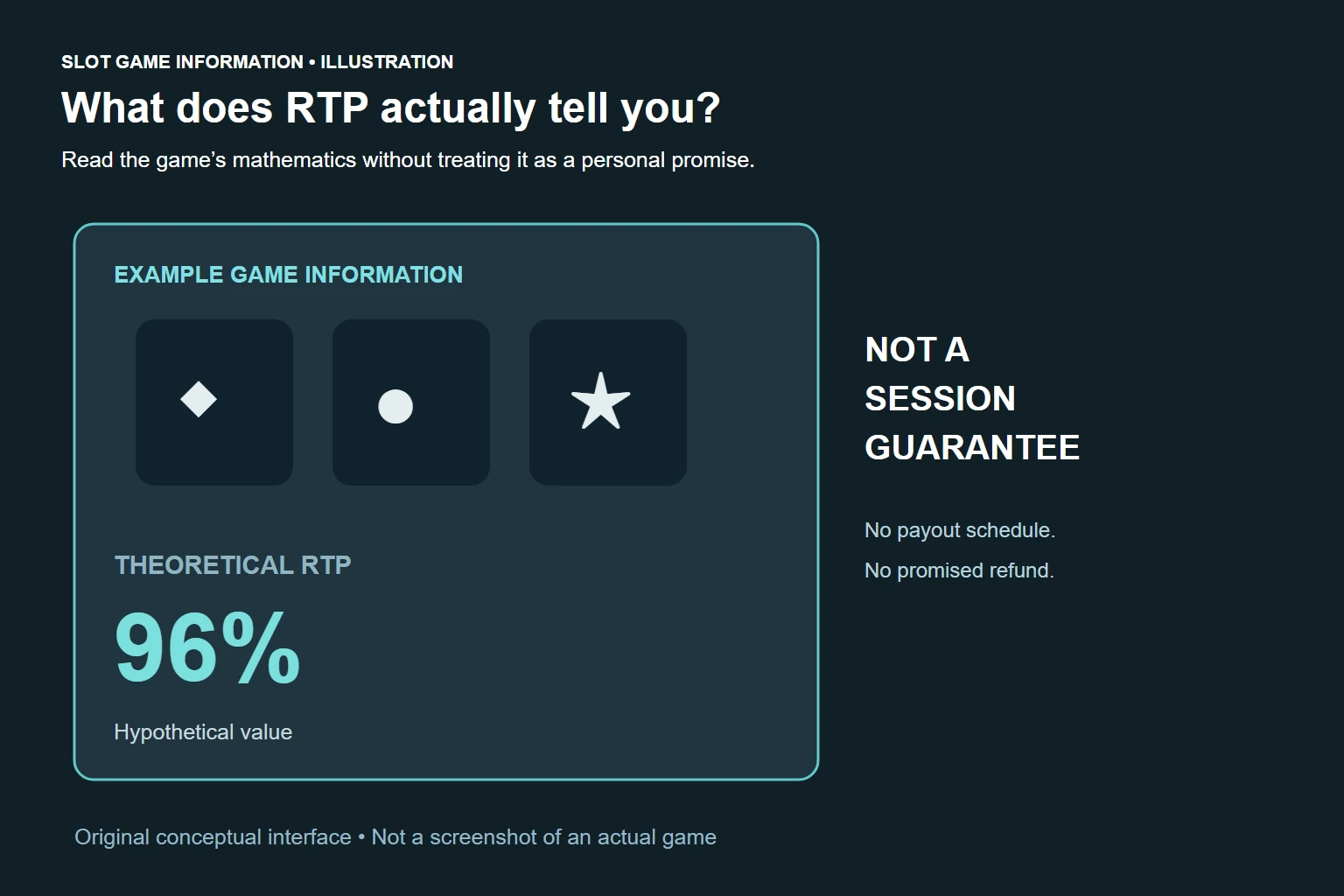
Does a slot displaying 96% RTP seem to promise that you will get ₱96 back from every ₱100? Start by separating the game’s theoretical percentage from your own result. RTP describes a long-run mathematical return; it is not a refund, a session target, or money the game owes you after a loss.
You can make the number useful by checking the rules for the exact game version, then reading RTP alongside volatility and the payout table. To understand a completed session, record cumulative wagers and payouts separately. Your deposit alone cannot supply that calculation.
- Use theoretical RTP to understand a game’s stated mathematical model.
- Use your own wager and payout records to calculate an observed return.
- Keep RTP, house edge, volatility, and hit frequency as separate ideas.
Read the number before drawing a conclusion
The UK Gambling Commission’s player guide explains RTP as an average measured over a significant number of plays, not a promise for each visit. We use that explanation for the mathematical concept, not as evidence of Philippine licensing or consumer-protection coverage.
For an illustrative game with a 96% theoretical RTP, the complementary house edge is 4%, assuming the same rules and calculation basis. Neither figure tells you whether your next spin will return anything. A percentage displayed without identifying the game or version leaves a question unanswered: exactly which configuration does that number describe?
Keep a note of where you found it: the in-game help screen, a supplier document, or a third-party article. An article about another version should not automatically replace the rules presented in your actual game.
Work through one example: wagers are not deposits
Imagine a fictional session in which the sum of all wagers is ₱1,000 and the sum of all payouts is ₱700. Its observed return is ₱700 ÷ ₱1,000 × 100 = 70%. That is a description of this example, not a prediction or a representative test of a real slot.
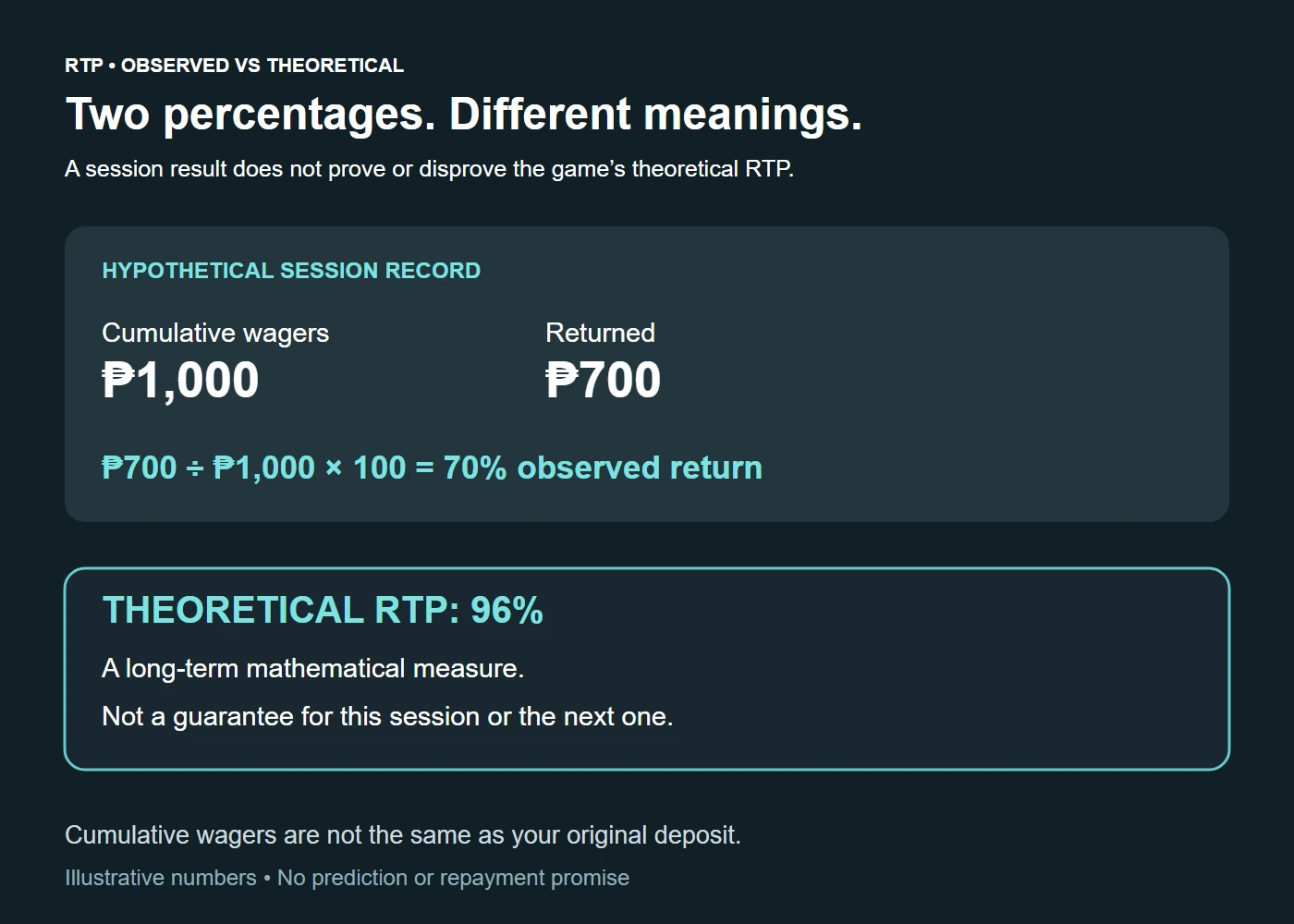
The difference between ₱960 and ₱700 is not a ₱260 credit waiting to be collected. Continuing to play creates additional wagers and uncertain outcomes; it does not turn the theoretical figure into a repayment schedule.
The regulator’s calculation guide expresses actual RTP using wins divided by turnover. Here, turnover means the accumulated amount wagered. If you reuse returned funds in later rounds, cumulative wagers can exceed the amount you originally deposited. Bonuses, fees, withdrawals, and any unfinished rounds need separate accounting rather than being silently mixed into a simple spin-payout example.
Separate RTP, house edge, volatility, and hit frequency
These labels answer different questions. RTP concerns average return within a defined model. House edge expresses its complementary expected share under the same assumptions. Volatility describes how uneven outcomes can be; a label such as “high” is not a timetable for a large payout. Hit frequency concerns how often a defined paying outcome occurs, which is different from how much it pays.
| Measure | Question it answers | What it does not promise |
|---|---|---|
| RTP | What proportion of wagers does the model return on average? | Your session’s return |
| House edge | What proportion does the house expect to retain under that model? | A fixed loss on every round |
| Volatility | How variable are outcomes under the game’s model? | When a larger payout will occur |
| Hit frequency | How often does the defined paying event occur? | The probability of finishing a session ahead |
Consider two invented sequences of returns from ten equal ₱1 wagers. One returns ₱1 on each of the ten rounds; another returns ₱10 once and nothing nine times. Both return ₱10 in total, but their patterns are very different. This illustration explains why a total-return percentage alone cannot describe the experience of individual rounds. It does not establish a game’s volatility or future results.
A paying outcome can also return less than its wager. Reading “win” on a screen is therefore different from confirming that the round produced a net gain.
To see how these measures are separated in an actual supplier document, the Nolimit City Hot 4 Cash game sheet lists total RTP, volatility, and hit frequency as distinct fields. This is an example of document structure, not a recommendation or confirmation that a particular operator offers that configuration.
Check the exact rules and the limits of the evidence
- Identify the game title, supplier, and available version information.
- Find the RTP statement in the relevant help or paytable, including any configuration notes.
- Read how features and any additional costs are described.
- Keep personal transaction records separate from claims about the game’s mathematical model.
A theoretical percentage is not an audit of an operator’s withdrawals, account controls, or licensing. Equally, one disappointing session is insufficient evidence that the published mathematical model is false. Those questions require different records and checks.
Common questions about RTP
Does a higher RTP guarantee a better session?
No. Comparing theoretical percentages does not establish the result, cost, or duration of an individual session. Check that the compared figures refer to identifiable versions before drawing even a mathematical comparison.
Can a game be due to pay after repeated losses?
Do not treat previous losses as a repayment promise. If your reason for continuing is to recover a supposed shortfall against RTP, the calculation above shows why that shortfall is not a debt.
Where should I go next?
For game terminology, see our online slot games guide. If losses or continued play are causing concern, the responsible gambling resource covers ways to pause and seek support.
Sources checked: 6 October 2026. Educational examples only; no account, game fairness, or payout testing is claimed.
Editorial methods and corrections