
How to Play Scatter in JILI Super Ace: Symbols and Rules
Understand Scatter in JILI Super Ace using official screenshots. Identify symbols, read feature information and distinguish the original game from variants.
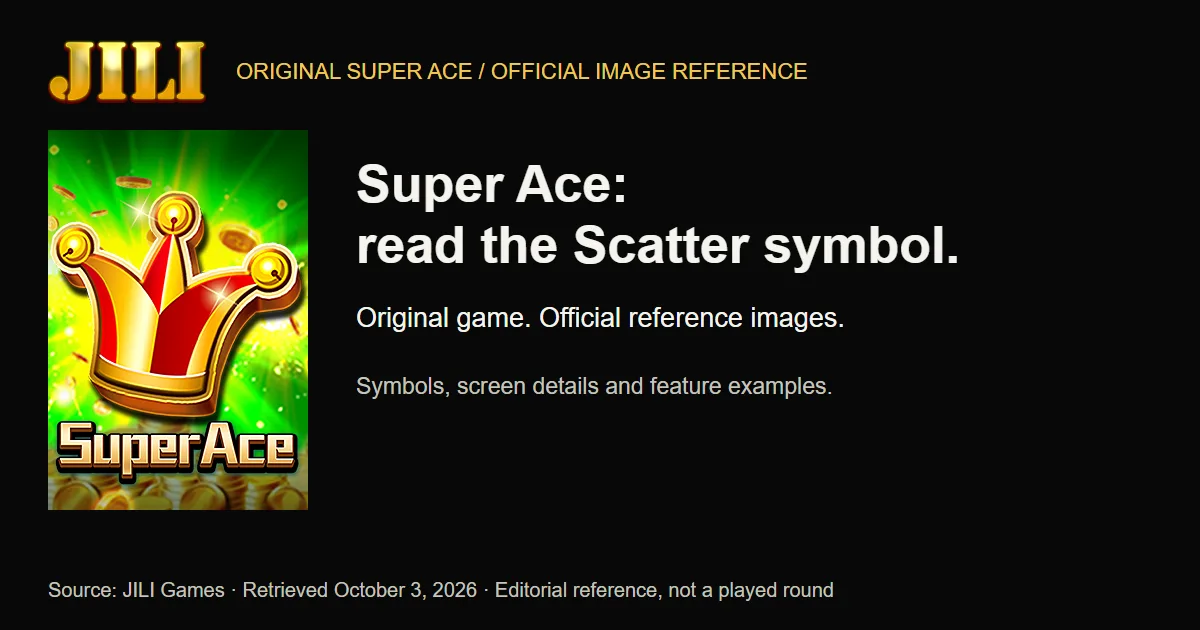
To understand Scatter in JILI Super Ace, first identify the original game, then separate its symbols, feature conditions and result displays. This guide explains how to read those parts using official reference images. It does not offer a winning system or instructions about how much to wager.
If your question is where a link leads or whether a page is impersonating a platform, use our Scatter entry and link-checking guide. This article answers the next question: what information does the game screen actually show?
Reviewed on 3 October 2026. The JILI logo and game images come from the developer’s public website. They are supplied product examples, not screenshots of a round we played. We did not deposit, spin for money, or test an operator’s payment service. LEGITCASINO is providing independent commentary; the use of those assets does not imply JILI’s endorsement.
Key Takeaways
- Match the complete game title before applying a guide.
- A symbol label, feature counter and monetary display answer different questions.
- Confirm the feature conditions in the loaded version’s rules; a screenshot cannot show every exception.
Start with the Original Super Ace
The reference for this article is JILI’s Super Ace product page, number 49. It identifies a slot with 1,024 ways and Free Game, Free Spin and Multiplier features. Its supplied images show a five-column, four-row board.
Keep the full title when looking up instructions. JILI separately lists 3 Super Ace, whose description includes three Scatter types. That separate listing is enough reason not to combine its rules with this guide. The same care applies whenever a title adds words such as Deluxe or Jackpot: establish the exact match before borrowing an explanation.
The brand mark identifies the provider in this article. It does not verify an unrelated website that displays the same mark. Game identity and platform identity require different checks. Our original entry-checking article handles the latter, so you do not need to treat a logo as proof of both.
Read the Screen Before Interpreting a Result
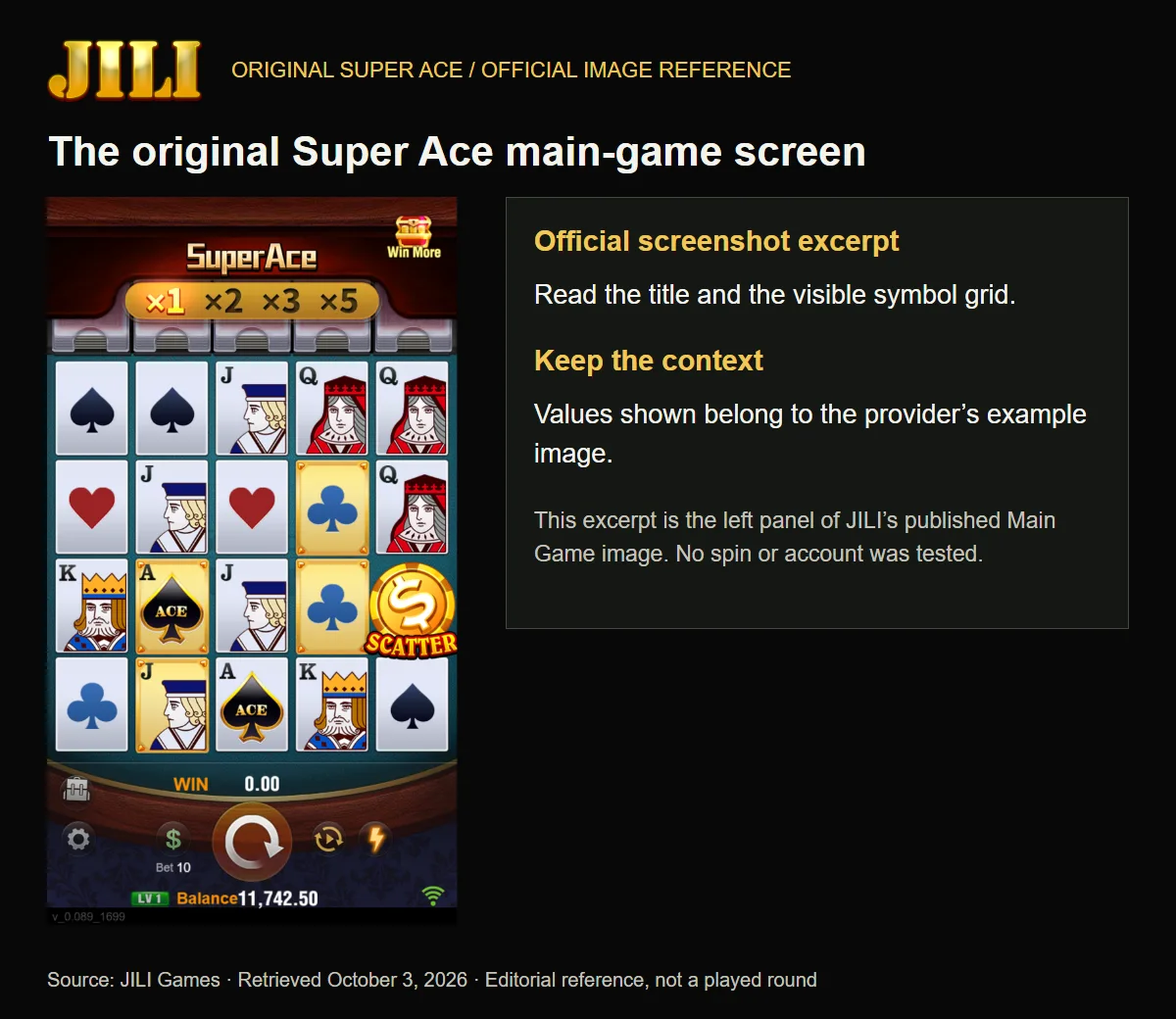
Use three questions when reading an unfamiliar screenshot: what is pictured, what is labelled, and what is still unknown? This prevents a bright animation or a large number from becoming the whole explanation.
First, find the game title and the main symbol area. Next, read the labels attached to numbers. A counter belongs to a different category from a balance. A result message needs its surrounding context. Finally, identify the information or rules control in the actual version you are examining; its location may differ from an older reference image.
Do not infer the order of events from pictures placed beside one another. The developer’s promotional image sets contain multiple example states. They are not a continuous recording with a verified starting balance and ending balance. Treat each panel as an illustration of what can appear on screen, rather than a documented financial history.
For a useful reading note, record the title, visible mode label and exact question you need answered. “What does this counter mean?” is more precise than “Why did the game do that?” A precise question makes it easier to find the relevant rule without guessing from the colours or animation.
Recognize Scatter, Wild and Golden Cards
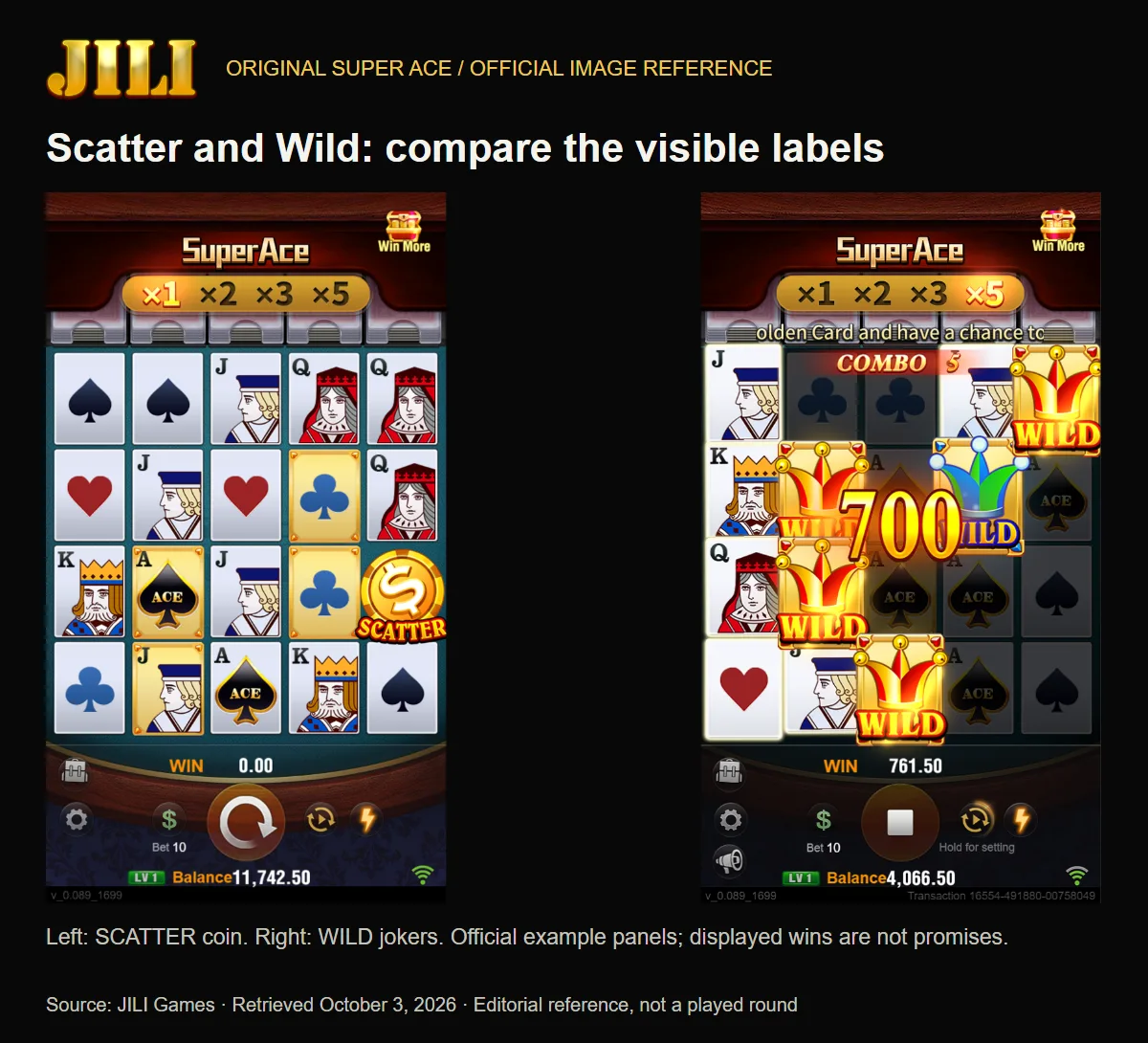
The official examples label a coin as Scatter and Joker symbols as Wild. JILI also describes a Golden Card becoming a Golden Joker after elimination. These are distinct visual and functional categories.
That distinction helps you ask the right rules question. For a Scatter, look for the feature condition. For a Wild, look for what it may replace and any exclusions. For a changing symbol, look for the event required before the change occurs. Do not assume that a symbol’s appearance alone proves its effect has already been applied.
Keep appearance and function in separate columns in your notes. The first can be checked against an image; the second requires rules text. If a guide says that two symbols behave identically, ask whether it names the same game version and documents the exceptions. A matching colour or shared card theme is not sufficient evidence.
Check the Scatter Trigger and Free Game Conditions
Casino Plus’s Super Ace Free Spin FAQ describes three Scatter symbols triggering 10 free spins. This is the operator’s published explanation. Confirm the applicable condition in the rules of the version you load; we did not verify a current room’s full rulebook.
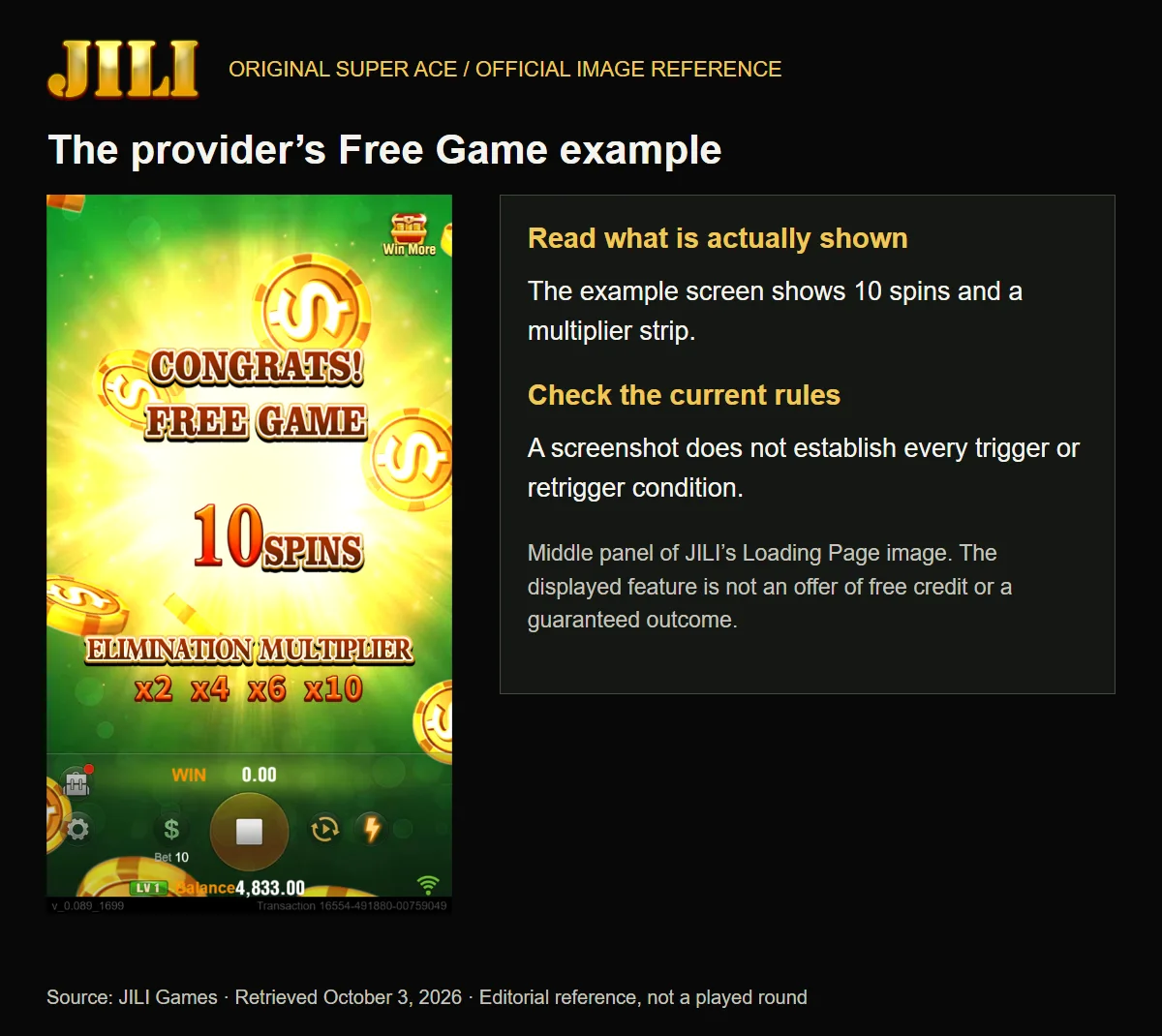
The developer’s reference artwork includes a 10-spin feature announcement and a red multiplier display. It supports the existence of those example states; it does not establish every trigger, retrigger or settlement exception.
When reading the help text, distinguish the initial trigger from any later extension. An announcement that more spins were awarded is not, by itself, a complete rule for when that can happen. Record the condition, the award and any limit together. If the source omits one of them, mark it unconfirmed rather than filling it in from another game.
Also separate an in-game feature from an account promotion. Casino Plus makes that distinction in its FAQ. A campaign can have its own dates and eligibility terms; a feature screen is not evidence that a reader has received a sign-up reward or withdrawable credit.
Understand Eliminations, Multipliers and Spin Counts
JILI describes successive winning eliminations increasing the multiplier. Its examples show main-game values x1, x2, x3 and x5; the feature examples show x2, x4, x6 and x10. These are documented reference states, not a measured return or a prediction.
Read the unit as well as the number. In an original notation example, x2 means a multiplier, 2 spins means a count, and 2 credits means an amount. They are not interchangeable. A multiplier of ten does not mean ten turns, and a ten-turn announcement is not a cash amount.
When following a screen explanation, identify its mode first, then read the relevant counter or multiplier. Keep a round result separate from a running balance. This gives you a more useful description than simply saying that “the number went up.”
Here is an original example. A cropped picture shows a large number but excludes its label. One reader calls it a balance; another calls it a round win. Neither interpretation is established by the crop. The missing label is the problem. A wider, unaltered image or the relevant result record is more useful than a guess based on the number’s size.
The same discipline applies to multipliers. A highlighted multiplier and an amount shown elsewhere are separate pieces of information until the rules explain their relationship. Do not calculate a payment from a screenshot unless the relevant amount, rule and stage of the round are all clear.
Common Misunderstandings About Scatter
A visible Scatter is not a prediction. Identifying a symbol tells you what is shown in that image. It does not establish when another will appear. This article does not endorse timing charts, signal groups or software that claims to know the next result.
A feature announcement is not a profit guarantee. The label explains a game state. It does not establish the net outcome of an entire session or make a gambling product a source of income. Avoid reading an isolated result as a promise about future play.
A supplied screenshot is not our test result. The images retain the developer’s example content. Any visible figures belong to those reference materials; they are not measurements of our winnings, return rate or withdrawal experience.
A similar name is not a complete rule match. Resolve the full title and version first. Our table-game rules overview uses different game families to explain the same documentation habit: match the rule to the exact product.
Frequently Asked Questions
Is Scatter the name of this game?
The game covered here is JILI Super Ace. The guide uses Scatter to identify the symbol topic in the reader’s query, rather than treating every game discussed as “scatter” as the same product.
Does this article verify every current Super Ace rule?
No. It identifies the original product, interprets supplied screenshots and attributes the operator’s feature explanation. A complete current in-game rulebook was not inspected.
Can these images prove what I will receive?
No. They are product-reference images. They do not establish an individual account’s eligibility, future results or service outcomes.
Where can I check a questionable entry link?
Use the separate entry-checking guide linked in the introduction. A gameplay explanation cannot authenticate a website merely because its page contains familiar artwork.
Sources, Images and Review Limits
JILI’s product page, logo and supplied screenshots were checked on the review date. Image excerpts are used for identification and commentary; copyright remains with the respective owner. We preserved the source files and placed editorial labels outside the game content. No game outcome or symbol arrangement was fabricated.
The browser reported a certificate warning when opening JILI’s catalogue, and we did not bypass it. The public product text was accessible through our web research tool, and the official image files were retrieved through normally validated HTTPS. Those methods supported this reference-based guide, not a claim of hands-on gameplay.
For our sourcing and correction process, see the editorial policy. For information about limits and support, see the Philippine responsible gambling guide. Account and transaction questions are addressed separately in our KYC and withdrawal-problem guide.
Editorial methods and corrections